A few weeks after Trump took office for his second presidential term I went to Mexico to visit the monarch butterflies. I’d visited their sanctuary in the mountains last year and this time around it felt like I was visiting old friends. I was excited to spend time with them but mostly I was anxious to know if they were okay. I was not okay. I’d gone from despair to catatonic in the weeks since the results of the presidential election. I was oscillating between being hypervigilant to everything this fool was doing and attempting to bury my head in the sand because I was overwhelmed. I was arguing with my friends, arguing with my husband as we all tried to make sense of the chaos. And because I’m one of God’s chosen warriors, over the holidays I learned information about my childhood that retraumatized me. How? Turns out repressed memories can come back, folks. Be careful out there. The anxiety of all of it got so bad that I started having night terrors again. All this to say, I was not okay. Instead of doom scrolling the news, I was deep diving for information on the status of this year’s monarch butterfly population.
I was worried about the monarch butterflies in Mexico because the butterflies in California’s central coast were also not doing okay. I went to visit the California monarchs in December and their population numbers had dropped from tens of thousands the year prior to low hundreds. At one point this season, there was a popular overwintering site that only had like 20 butterflies. That’s bad! I wanted to know how Mexico’s monarchs were doing before we got there so I could emotionally prepare myself for the worst. Yes, I have abandonment issues.

I turned to nature during Trump’s first presidential term. I yearned to be near water. I can’t swim but that doesn’t stop me from getting knee deep in the Atlantic ocean at Rockaway Beach. I was there for the vastness and for the sound of crashing waves. When I stare at the ocean and at the horizon, I don’t feel small. I’m not reminded of my insignificance in the universe. Instead, I feel big. I imagine I’m a giant and when I float on the water I take up a large portion of the ocean. On my back, I can reach to the sky and pluck a cloud or a star if I want. As a giant floating on the ocean, I’m rocked back and forth by the moon. And when I feel better she ushers me to the shore on a wave. I leave the water remembering I am big, bigger than any pendeje trying to hurt me.
In “The Beautiful Unforeseen,” an essay in Orion Magazine, Sandra Cisneros writes about falling in love with nature and the land. The idea is that if we fall in love with nature, we will want to protect her the way we would a lover. Cisneros writes, “When I was young, I was obsessed with looking for love in a single person, without realizing love was being offered to me all the time. Now that I’m older, I’m more a lover than ever, but my lovers are the trees, sky, animals, earth, plants, universe.” I aspire to this level of connection with nature. I have spent the majority of my youth desperately wanting love from people who couldn’t love me and I wasn’t seeing the love that was all around me. The trees, the birds, the flowers, the plants, the wind, they’ve been there and I’ve been taking them for granted. I’ve always been a fan of the monarch butterfly but I didn’t fall in love with them until I started doing research for a novel I’m working on. The first time I saw monarch butterflies burst from their resting place on a tree and fill the sky with their orange and black wings, I cried. I apparently hadn’t known beauty until I saw them dance. I’ve become obsessed with their well-being, with their environments, and with what’s causing their decline.
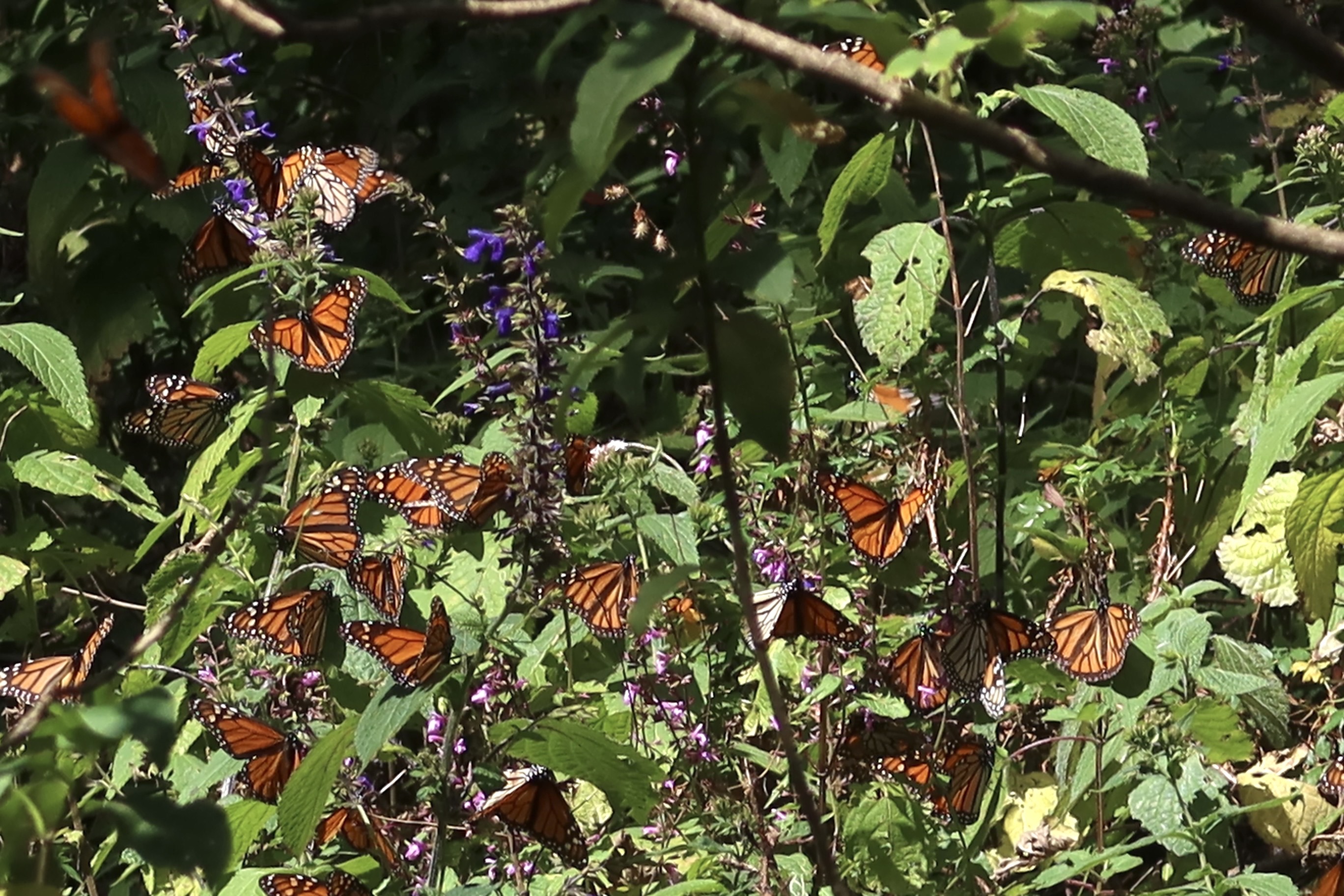
The hike to the monarch butterflies’ sanctuary in the mountains of Michoacán is challenging. It’s about a three mile walk up a steep cerro where the air is thin. Our tour guide, Doña Fabiola, was a short and plump elderly woman with the energy of someone much younger. She was patient with me for most of the way up the mountain. She’d encourage me to pick up the pace by telling me that she’s seen gente más grande go up the mountain. “Si, Doña Fabiola,” was all I could say to this tiny woman who reminded me of everyone’s grandma. To get her to slow down, I’d point to wildflowers and trees and ask her to tell me their names. She’d stop to point and ask me to sniff and feel the plants. My chest and legs burned and it felt like we were never going to arrive at the monarchs until eventually we saw one flying down, then tens, and then we were surrounded by thousands of them. Of course I cried. Because there they were and they were okay.

On my way down the cerro, I overheard an elderly señor explain that in the spring, the monarchs will head north to the US and to Canada. He said, “Por lo menos a las mariposas no les andan pidiendo papeles.” He and those around him laughed a laugh that ended with a sigh. We all understood why. The news of Trump’s immigration policy changes and mass deportations didn’t escape me while I was in Mexico. I was at the airport when I learned about Jocelyn Rojo Carranza’s death. She was an 11-year-old girl who was being bullied and threatened at school for her immigrant background. News outlets report that students taunted her and other Mexican students with calling ICE on their families, which the school denies. News outlets are now reporting that just before her suicide, Jocelyn had been sexually abused by a family member, which the family denies. In all of the articles I read about Jocelyn, different people want answers for what happened and all these people are pointing the finger at someone else. There were multiple spaces where Jocelyn was not safe. Today, the country is being led by a sexual predator and a xenophobe. The dots are all there to be connected and the grief around my throat won’t let me get the words out. The truth is that Jocelyn should still be here. My heart breaks for Jocelyn. And for all the 11-year-old daughters of immigrants who were and are being bullied at school and abused at home. Who will protect us?
At the top of the hiking trail on that cerro in Michoacán, I stood as close as I could to the thin rope separating us from the trees where the monarch butterflies rested. I thanked them for their glory, for still being here, for not abandoning me. Silently, I shared an offering:
Overwintering
In the cold months, monarch butterflies rest.
Their DNA reminds them Spring always comes
and the difficult labor of surviving continues.
To live through the winter, they cluster up high
in the oyamel or eucalyptus trees and share each other’s protection.
When the sun shines, they remember to play.
They spread their orange and black wings to dance against the sky.
In the trees, they are a kaleidoscope of unthreatening dead leaves.
As a group, as a burst, there is no sky, there are only butterflies.
Huddled together, clinging to one another, monarch butterflies
remind us there is no better defense than community.
The trees may fall. We may bulldoze, chop, and sell their lumber.
We warm the earth. The rains and winds get stronger. And, yet.
Generation after generation, monarchs still fly
hundreds and thousands of miles to land where their ancestors rested.
Year after year, it’s not certain how many of them will survive.
Many and few return to their overwintering sites to try.
In the cold months, monarch butterflies rest.
When Spring comes, we will rise to the skies with them.
I’m preparing for the start of Spring semester and as it’s to be expected, I’m riddled with anxiety for my students’ safety. I won’t make it through the semester if I continue to drown myself in the daily news. And there’s definitely no way to ignore everything that’s going on. So I’m turning to nature. I’m reading more poetry. I’m still trying to get my hands on Ada Limón’s collection Shelter: A Love Letter to Trees, where she writes poems to trees that have grounded and inspired her. Maybe I’ll write poems to the trees that have been there for me, even when I wasn’t looking. Maybe I’ll write love letters to flowers and their pollinators. I’ll definitely be writing more about monarch butterflies. A lot is going on right now and Trump is causing a lot of harm. My resistance will now include spending more time falling in love with nature, seeing the love that’s around me.
I’m currently reading: Gina Chung’s “The Arrow,” a short story for One Story. In “The Arrow,” the protagonist learns they’re pregnant and they have a choice to make. The voice in the story is amazing, the use of second person POV is powerful, and the mother/daughter story will punch you in the heart.
I’m currently listening (on repeat) to: “Goliath” by Jessie Reyez
 Sonia Alejandra Rodríguez