At the beginning of the summer I went to see a matinee performance of “Real Women Have Curves: The Musical.” A friend and I bought last minute tickets to a show the week before it was set to close due to “low sales.” I wasn’t prepared to be so moved by the story and the songs. It had been many years since I had seen the film by the same name and many more years since I’d read the play by Josefina Lopez. I went in with the general idea: Ana is a young Mexican American woman struggling with her family’s expectations and at some point they all disrobe to celebrate their diverse bodies. It’s a story about immigrants, about complicated mother/daughter relationships, and about coming of age in the US as a young person of color. While these stories are part of my everyday reality, by the time I went to see the show the US government via ICE had been violently targeting immigrant communities. My body had been vibrating with fear for months. LA was heavy on my mind as I took my seat for the performance.
The fear I learned as an undocumented child has not left my body. It’s in my muscles, in my bones, in my marrow. I feel it in my arthritis, in how easily I startle, in the decisions I make about my future. Recently, this fear bubbles to the surface more often than I’d like and I can’t help but cry. When I can no longer push down the fear, when I can’t contain it, when it punches me in the gut, I cry a cry heavy with grief. These moments feel like more than panic attacks. I know all of the tears bursting through me are not just mine. I’m reminded of Karla Cordero’s poem “Leaked Audio from a Detention Center”:
“hear how the children eat their tears
how the rain in their throats demand to be a river”
I heave with panic because I’m trying to not drown in the river pouring down my face.
This past June, I attended the International Research Society for Children’s Literature conference in Spain. I was scheduled to present on Aida Salazar’s middle grade novel in verse, Land of the Cranes, a powerful story about a Mexican child who imagines herself as a crane while in detention with her mother. My 20 minute presentation was taken from an essay I was working on for an academic journal. I knew my presentation would be emotionally challenging because I’d be talking about children in detention as families were being separated in LA. I practiced and timed myself several times in my hotel room. I dedicated my presentation to Jocelynn Rojo Carranza, the 11 year old from Texas who died by suicide earlier this year due to bullying because she was an immigrant. The argument that I was making about the legibility of immigrants’ humanity and the limits of humanity was important to me and I wanted to convey my message clearly. My presentation was going fine even as I felt fear rattling around in my chest. But then I got to this quote from the book where Betita, the protagonist, says:
“Despair is to be without hope, lost.
I feel despair drip into my veins
like a poison starting to take over.” (185)
The word “poison” was bitter on my tongue and as if my body was trying to purge a toxin, I burst into tears. I forced myself to blubber on about the ways the US government is harming immigrant children and adults today and poisoning their futures. Spain was experiencing a heat wave at that time. Heat waves earlier in the year had caused blackouts in Spain and Portugal. The conference rooms on this day were hot and steamy. My face was flushed and my tears were extra salty but I whimpered through the rest of my presentation anyway.
Earlier in the summer, in NYC, I had ugly cried in the James Earl Jones Theatre. I didn’t know then that this would be my new condition– that I’d start to cry so hard that my body would not feel like my own. The stark difference between the Real Women Have Curves musical and the film (and there are many differences) is the inclusion of an immigration raid near the garment factory where the women work. I fully believe this scene is the reason the show was closed early. Throughout the story the women are sprinkling clues that la migra (or INS in 1987 when the story takes place) is patrolling the area and abducting people. Before they realize there’s a raid happening next door, the women are laughing and probably signing. And then chaos. The women sit in the dark on the floor whimpering as they hear agents scream, doors slamming, sirens blaring, and migrants pleading. As soon as the women hit the floor, I was also sobbing. Everyone in that theatre was in the dark listening to an audio recording of an immigration raid next door. Time and space folded and we were in 1987 and in 2025. I shook in my seat, held on to my face mask, and tried to swallow a flood.
The ICE raids in LA were all over the news and social media. ICE was abusing its power and protestors were taking to the streets. The community was coming together to figure out how to protect one another. People were developing emergency phone trees, ICE watch groups, and offering KYR workshops. By the end of the summer, ICE would be terrorizing immigrant communities in Chicago including my hometown. My morning family chat group would become a barrage of buenos dias/ como andan/ ojo, que ICE anda for la Cermak/ ICE took people at Home Depot/ ICE is near the high school/ ICE/ ICE/ ICE / que dios las bendiga y las acompañe. I would shiver with fear as a heat wave washed over NYC.
In Spain after my presentation I walked around the conference area listening to the Real Women Have Curves soundtrack. I was one of the few people out there because it was the middle of the afternoon and there was barely any cover from the heat. Between my sunglasses and the orange light from the sun, Spain was looking very sepia. The people at my presentation had been kind and empathetic. As was my friend when I cried during the musical. I was mostly embarrassed and definitely drained in both instances. As an undocumented young person, I didn’t have a violent confrontation with ICE. But my mother was so afraid of family separation that it deeply controlled how we behaved and the secrets we kept.
My favorite song from the musical soundtrack is “If I Were a Bird.” The song is performed by Itzel, the young Guatemalan character, after the immigration raid scene and before she’s detained by INS. The song is about flying:
“So far beyond, and gracefully out of reach
From la migra, politicians
And boys who just wanna, y’know
If I were a bird, I’d shit on that.”
For the rest of the summer, my body hummed with fear. And I thought about girls who want to be birds.
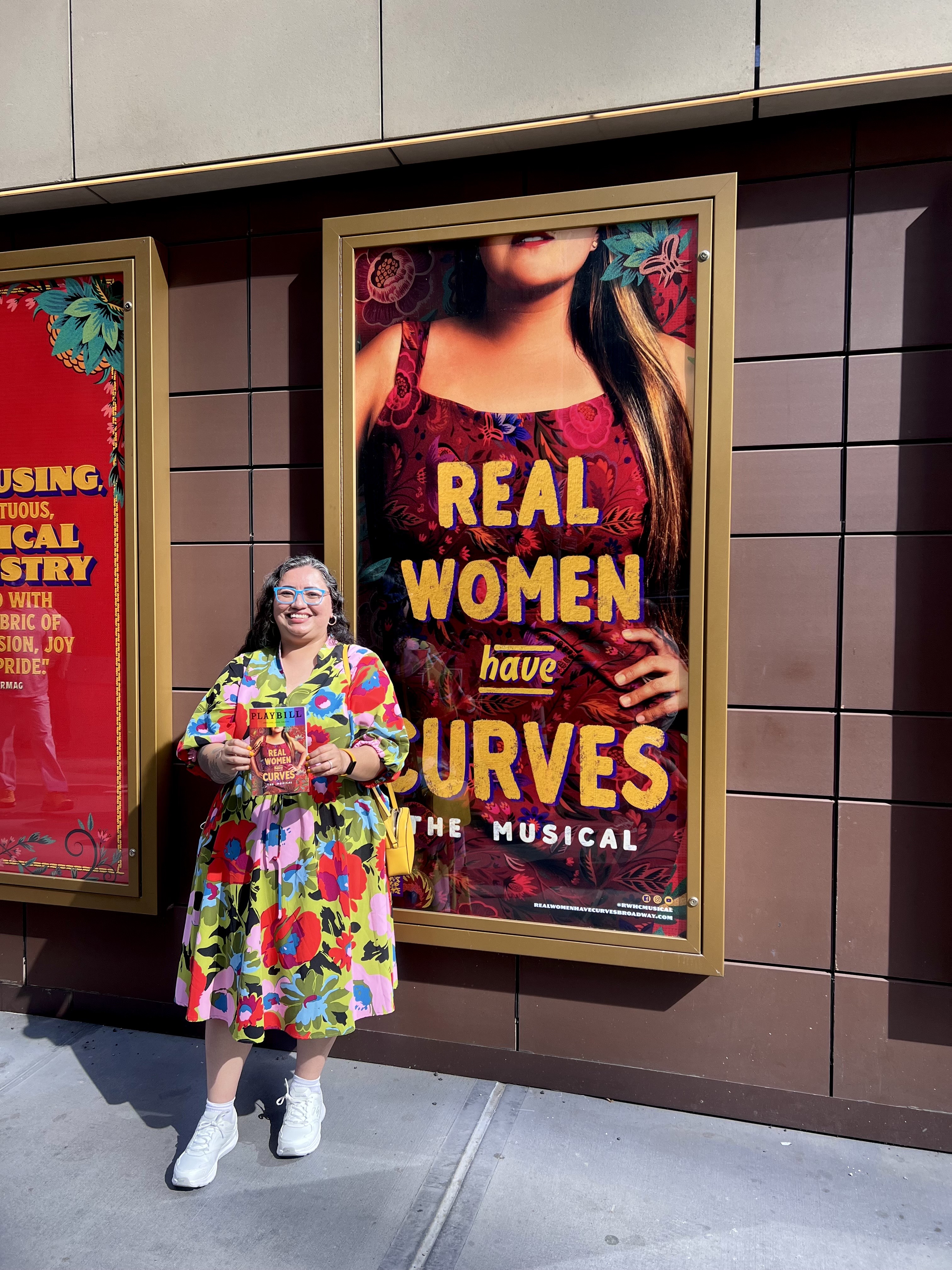
 Sonia Alejandra Rodríguez