I found myself stuck in traffic in México City when I happened to be in front of the apartment building in which my grandmother says she lived, in the neighborhood where my mother also grew up. I was on my way from Coyoacán to El Museo del Palacio de Bellas Artes. I had only gotten the apartment building address from my grandmother, who still remembered it, a few days before, and I’d saved it on a map app with no intention of going out of my way to see the place. I was sitting in traffic, in the back of a hot Uber, in front of this building for minutes before I glanced at the map and realized where I was. Every time I travel to México City, I try to locate us. Even as both my grandmother and mother would prefer that I’d let the past be. I took pictures of the building and tried to see them on the street. The weeks following my trip, my chronic pain flared up. Nowadays I walk with a slight limp because the joints in my feet hurt. The chronic pain associated with my disability sometimes feels like my body is stuck in traffic in a car without cool air. My joints can get rigid and my body can get hot with inflammation. A stagnant stillness envelopes my body making me feel like I’m growing roots and turning into a tree.
Recently, as I deal with my own progressing disability, I’ve been thinking about Frida Kahlo and her disability. In my essay “Lovely Inheritance” for Huellas Magazine I write about getting diagnosed with Psoriatic Arthritis (PsA), surviving generational trauma, and figuring out how to live in my body. I’ve been thinking about Frida because, for better or worse, she’s everywhere. She’s often surrounded by controversy because she appropriated Tehuana culture and it turned out her mother wasn’t even from Oaxaca. She downplayed her privileged background and affluent family which no doubt, in many ways, helped her succeed. Of course, the overcommercialization of her face and fashion choices continues to exoticize México’s indigenous identities. Earlier in the year, her presence felt more palpable for me in NYC because of all of the promotion going on for The Metropolitan Opera’s El Último Sueño de Frida y Diego. I was also in Coyoacán for spring break on a writing retreat to work on my novel.
My PsA for the last couple of years has been an invisible disability. My joints don’t have visible knots or at least not any obvious to anyone who doesn’t have arthritis. Folks make all sorts of assumptions about my body, in general, because I’m fat. Society always associates fatness with illness and disposability. Having an invisible disability with chronic pain as a plus size person looks different for me on a daily basis. I can go months with manageable symptoms and sometimes I need to take it a day at a time. I was having really good months. I felt stronger than I’d felt before. Moving around felt easier. The pain in my joints was a quiet hum I could ignore. I didn’t mind going up the stairs or walking long distances. My arthritis is worse in my hands and shoulders and I felt better because I could open jars with my hands. I could hold and carry stuff without my body reminding me that there’s a future where I might not be able to do any of it without assistance. The pain is back. This time it’s not a hum but more like someone right next to me on the subway watching TikToks really fucking loud.
In April, I planned a writing retreat for myself and I stayed in Coyoacán, around the corner from Frida Kahlo’s Casa Azul. I try to take solo trips when I can, mostly to remind myself that I can be alone. Since my diagnosis, traveling has been different in a myriad of small ways. I now have to consider how much I pack in my carry-on because I’ll need to lift it over my head to put it in the cabin. Will I be pain free on the day that I travel and what if I’m not? Twisting a cap on bottled drinks sometimes is painful and on other days I can do it all day. The place I stayed at in Coyoacán had a narrow spiral staircase to enter and exit. I had to go up sideways to fit my hips and hold on to the railing for dear life, through the pain in my hands, so as to not fall. Because I was in the neighborhood, I wondered about how Frida navigated her disability as an artist. The narrative of resilience is a common trope for people with disabilities. Would I know who Frida is today if her body had not broken and continued to break until her death? How will my disability inform my art?
Much of Coyoacán has some sort of representation of Frida Kahlo’s life. There are several murals, so many souvenir carts on street corners, and a lot more tourists with their swag. Many of these reproductions have yassified her face so much I was starting to forget what she actually looked like. Fridamania has erased her disabled body. I found myself getting upset on a vacation I paid for with my own money because the dominant narrative about Frida I was consuming in México City centered on the pain she experienced because of her relationship with Diego Rivera. Their toxic relationship gets romanticized left and right and Frida’s disability becomes secondary. While in Coyoacán, I attended a performance of a musical about her life. It was obvious from the way the creators talked about the musical that a lot of effort went into this production. The performers were super talented. However, the images of the painter that were used in the background were the face-tuned versions and the heart of the story was, yet again, Diego Rivera. Frida was represented as not having a backbone, literally and figuratively. She was a submissive woman, a woman in pain, a woman obsessed with one man. Frida was the butt of a joke when she decided to remarry Diego. There was no mention of Frida’s sexuality and her other romances with both men and women. I was a snob annoyed at a community theater performance. I angry ate my popcorn drenched in Valentina sauce in my surprisingly comfortable theater seat. The musical then got to the part where Frida had a miscarriage, and how she wanted to have this baby for Diego, and if only her body had been different. I started sobbing, choking on my tears and popcorn kernels. I haven’t had a miscarriage. But I also haven’t been able to have a baby. The number of times I’ve wished my body was different, better, healthier so I could give my husband a baby is painful and I felt for Frida.
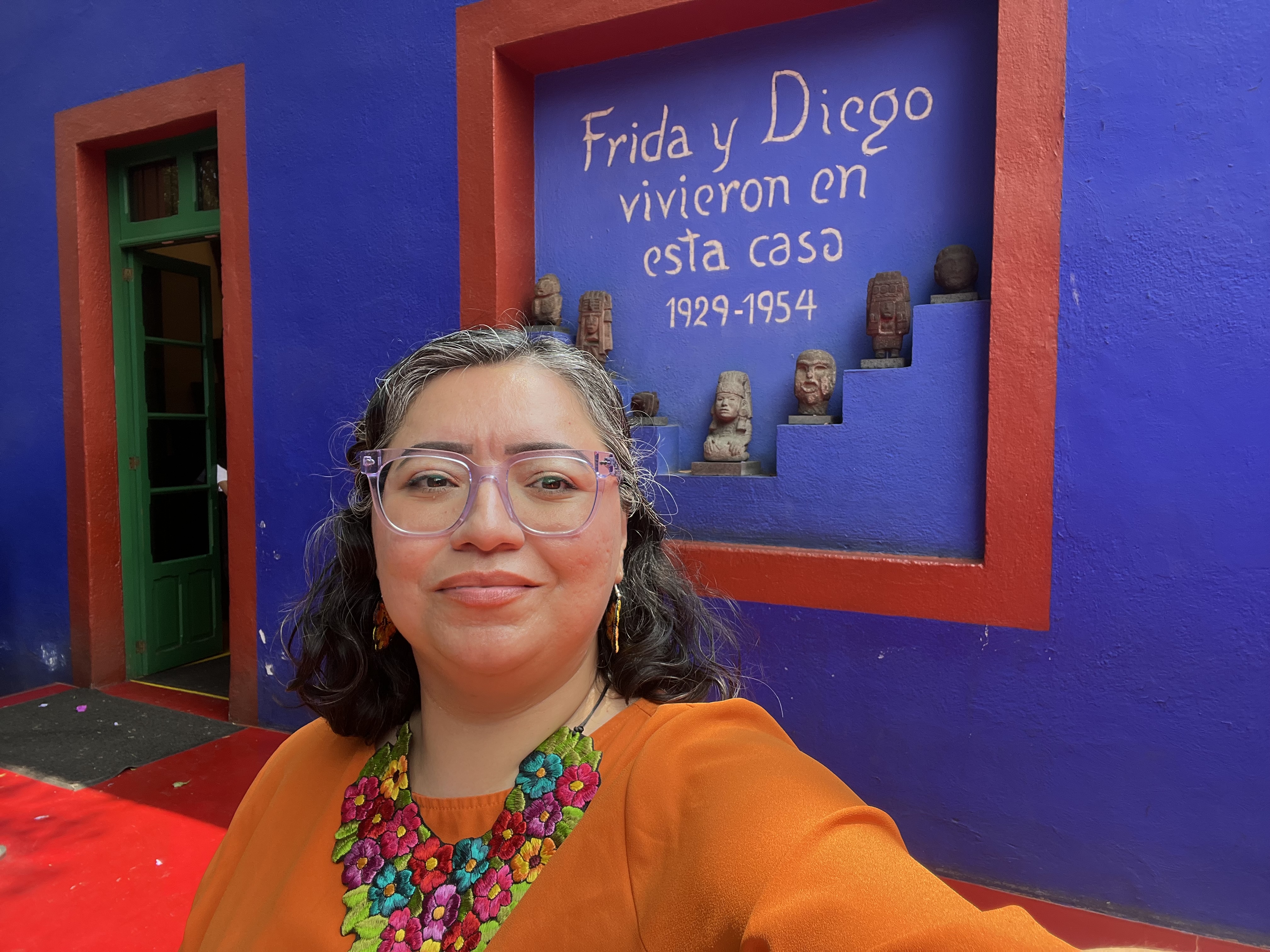
The first time I was in México City, when I could afford to travel and vacation, was on my 30th birthday with my husband. PsA can be hereditary. My mother and my sister have it. At 30, I wasn’t showing signs that I also had it. When I walked through La Casa Azul the first time, I didn’t see Frida Kahlo’s disability. This time around, about to turn 39 with active PsA traveling solo, all I saw were the ways she tried to “disimular” her disability. “Hide” isn’t a complete translation for the Spanish word “disimular.” The word “simular” means to pretend something is real, to simulate. As in pretending to have a healthy body when that’s not the case. “Disimular” is more like putting a disguise on something. Disimular feels like an in-between space where Frida decided when or how her disability was visible and on display and when it wasn’t. As I walked through La Casa Azul, I began to wonder, what the fuck was Diego doing to help? When I met my husband I didn’t have a disability and the visions for our future looked a certain way. Now we’re both navigating my disabled body together. And that shit has been tough. How many times are we going to argue about not filling the water jug all the way because it physically hurts my hands if it’s too heavy? If we have children, will I pass on my PsA?
On my tour of La Casa Azul this year, I walked near a tour group to hear what the tour guide had to say. We stopped at the entrance of a small bathroom where after Frida Kahlo’s death in 1954, Diego Rivera asked that many of her belongings be locked away. They were locked away until 2004. Locked away in the bathroom were Frida’s corsets, crutches, prosthetic legs, and other medical equipment alongside sketches, jewelry, photographs, and many of her dresses and huipiles. The first time I went to La Casa Azul, I gravitated toward the clothing and the jewelry. This time I thought about what it meant to lock away the physical reminders of one’s disability. Then to have them prominently displayed many years later for tourists to photograph and post on social media. The majority of the items had been displayed in a separate part of the house in an exhibition titled “Las Apariencias Engañan.”
The tour group continued to walk ahead, and I followed closely behind. The tour guide stopped at an unfinished pencil sketch of a self-portrait that centered Frida Kahlo’s face and upper body. The tour guide speculated that Frida didn’t finish this self-portrait because her disabled body was more obvious than in other self-portraits. To me, the sketch looked like opening the phone camera at an unflattering angle and asking, is this what I look like? Because that’s not how I want others to see me, I find a better angle. The tour guide, who in general had many speculations about Frida, suggested that the reason the painter wore long skirts was to “hide” her limp. For most of her life, Frida had a limp and needed orthopedic support. The flow and dance of the long skirts hid her choppy walk. Near the room where all her dresses were displayed, which was a much darker room and separate from the main house, there were small photos and sketches hanging on the walls. Among them was the famous Frida sketch of feet in a vase with the words: “Pies para que los quiero si tengo alas pa’ volar. 1953.” This famous quote today is a resounding song of resilience and we often forget, or most of us don’t know, that Frida was talking about her disability, about having her leg amputated. In her diary, after this moment, she often sketched herself with wings.
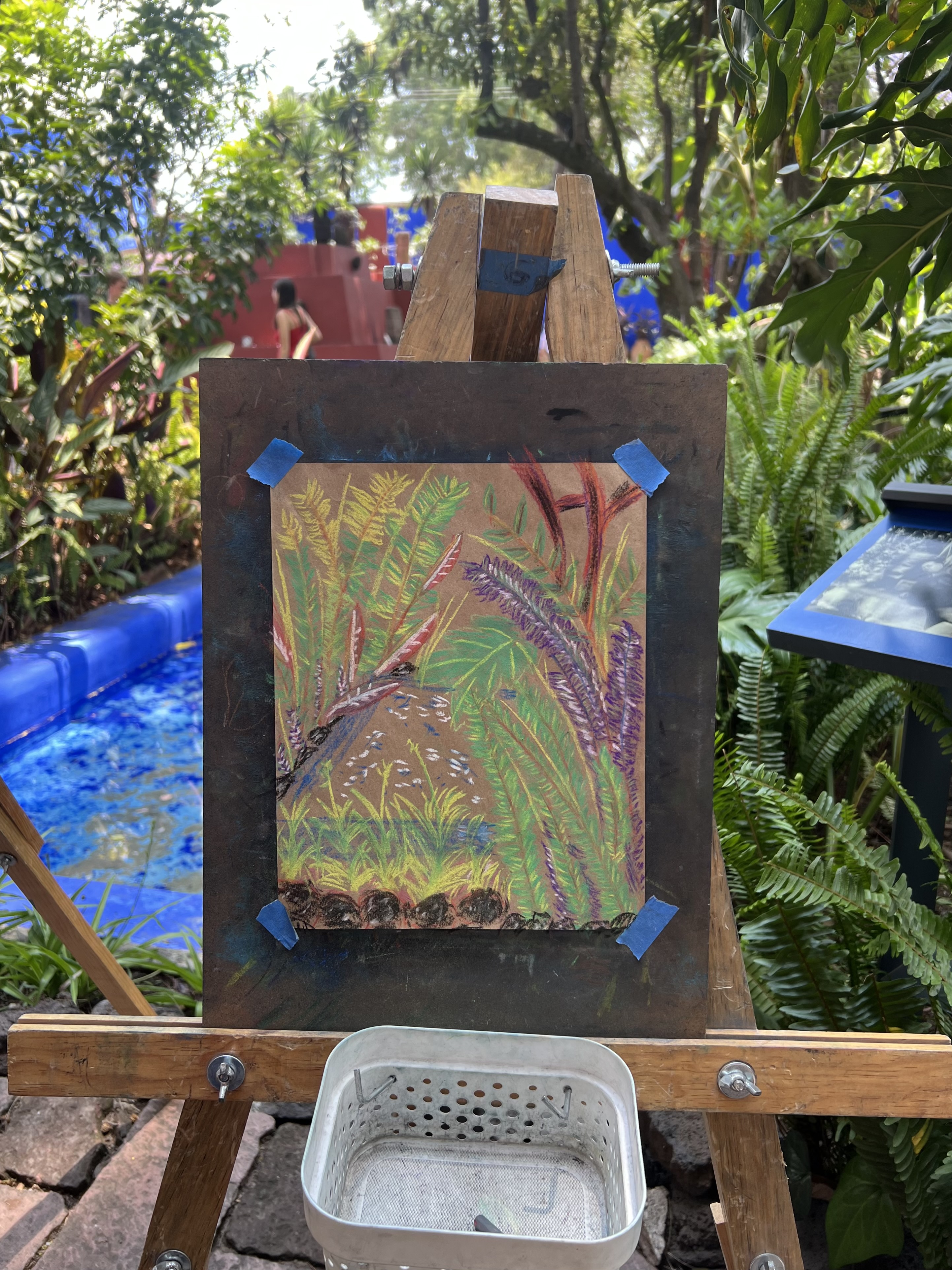
Another small sketch in the museum that drew me to a corner of a dimly lit room was of Frida Kahlo cloaked in a see-through dress that shows her naked body, a metal rod as her spine, and drawings of blue butterflies on the leg that was amputated. Underneath the sketch she wrote: “Las apariencias engañan. Frida Kahlo.” A simple period separates the title of the sketch and Frida’s name as a signature. If it had been a comma, a brief flick of pencil, and there would have been a speaker reminding Frida that appearances are deceiving. After walking through the museum, I sat in the garden patio by a reflection pond to participate in an oil pastel drawing workshop. I was the only adult participating. I sat in that garden, surrounded by children, for about an hour sketching the pond and the plants. At first, I looked around the patio, noticing the small steps connecting one area to another, the gaps between the cobblestones, and the unevenness in some areas of the ground. Did it hurt Frida to move about her own home, too? The green, blue, and red oil pastels covered the tips of my fingers and soon I only saw the pond and the plants in front of me and could only hear the scrapping of color against paper.
In May, I attended two performances of El Último Sueño. The colors, the dancing, the music, the singing was absolutely beautiful, which became even more apparent the second time because I was closer to the stage. The opera, created by Gabriela Lena Frank and Nilo Cruz, tells the story of a dying Diego who wishes to see Frida one last time. Frida has refused to visit the land of the living on Día de los Muertos despite the many altars in her honor. In what he feels is his last year of life, Diego begs La Catrina to convince Frida to visit him. Eventually Frida is convinced to return to the land of the living by Leonardo, a gender nonconforming spirit dressed as Greta Garbo. Frida and Diego reunite. Gabriella Reyes, a Nicaraguan-American soprano, played La Catrina in El Último Sueño and she was completely stunning. What I loved most about the opera was the focus on Frida’s physical pain. In the opera, Frida explains that she hasn’t wanted to return to the land of the living because she doesn’t want to return to the pain. There is also reference to the emotional pain because of Frida’s relationship with Diego. But Frida decides to return to the land of the living after La Catrina informs her that if she were to return, she would return pain free. Leonardo asks Frida to imagine what it would be like to create art without the physical pain. They sing this beautiful song about Frida’s true love for colors.
I can’t remember what my body feels like without pain. There was a time in my life when I thought I’d drown in the emotional turmoil I was experiencing. When I didn’t drown, when the ache didn’t feel impossible, I felt lost because I didn’t know who to be, who I could be without the pain. I’m not writing this because I’m seeking unsolicited medical advice, but because I don’t know how else to grieve a body for which I’ve fought so hard to make feel like it belongs to me. My art helps me process all the iterations of my body that were used as vessels for abuse, containers for self-hate, and holders for trauma. My art helps me embrace newer versions of my body filled with compassion, grace, and love. When Frida began singing in El Último Sueño about the possibilities of having a body without pain, of what her life could be, I leaned forward in my seat toward her melancholic siren song. I was on the edge of my seat because I can love my body for what it is now and still grieve what my body can’t do, what my body might become because of chronic pain. As I write this, my body aches. I wish I could remember Frida’s words at that moment. All I have is a memory of her anguished face and her hopeful brown eyes.
When I practice my art, it’s often to leave my body and quiet my mind. But living with chronic pain has meant that I need to always be conscious of my body. If I’m not, my body will turn up the volume on the pain. I started taking digital photography classes this year and practicing photography has required that I keep my body even more at forefront. On some days, I can’t hold the camera up for too long because it hurts my shoulders and wrists and then my hands begin to shake. I’m limited on the types of angles I can shoot because of my mobility issues. I struggle with low angles because of my knees. I won’t be climbing up anything to get the shot. There are many days when I’m creating, that a tiny pang in my heart wonders what making art without the physical pain would be like. Even as I practice gratitude that I can create art at all, the longing for a different body is a popcorn kernel stuck in the back of my teeth.
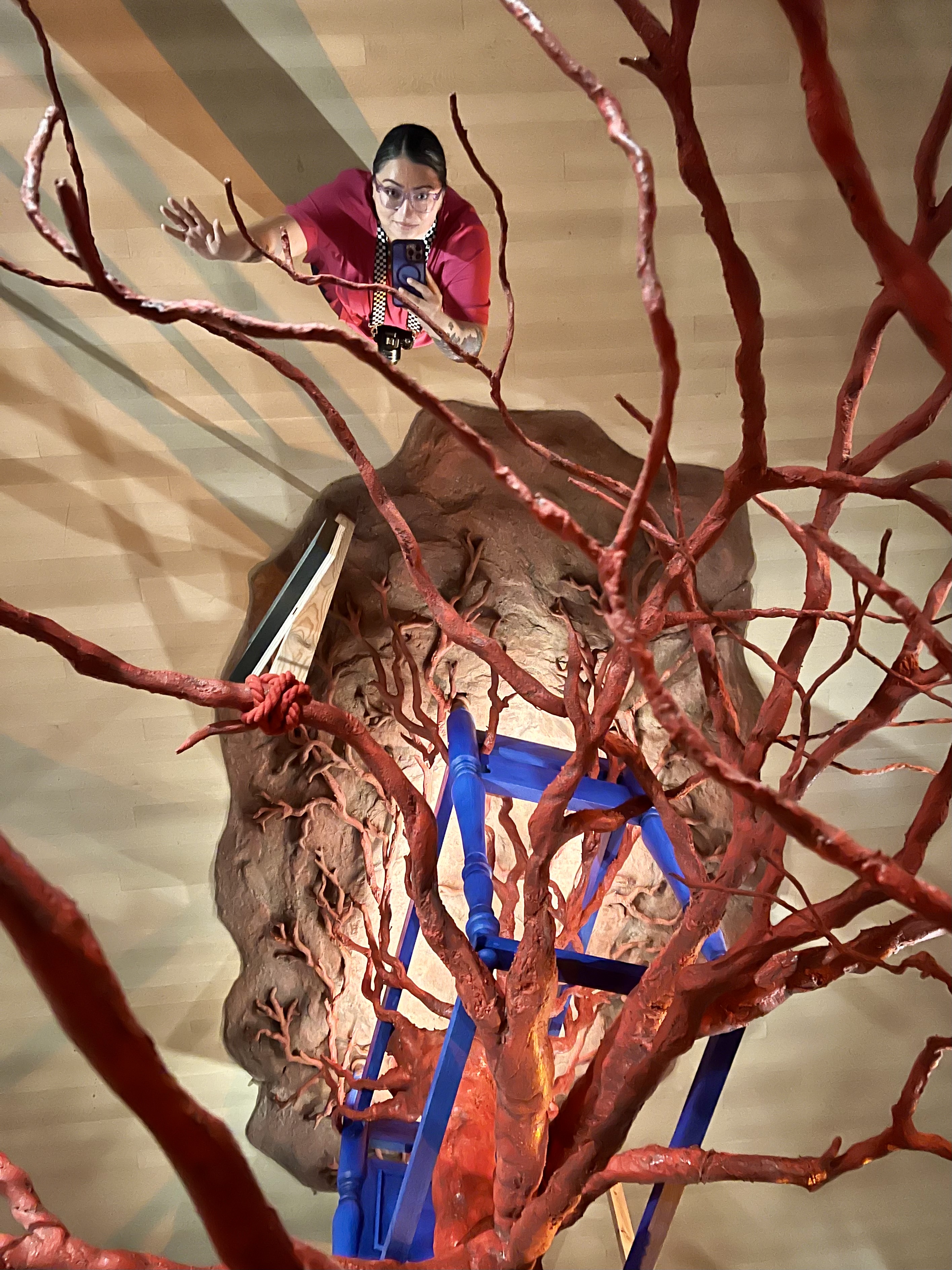
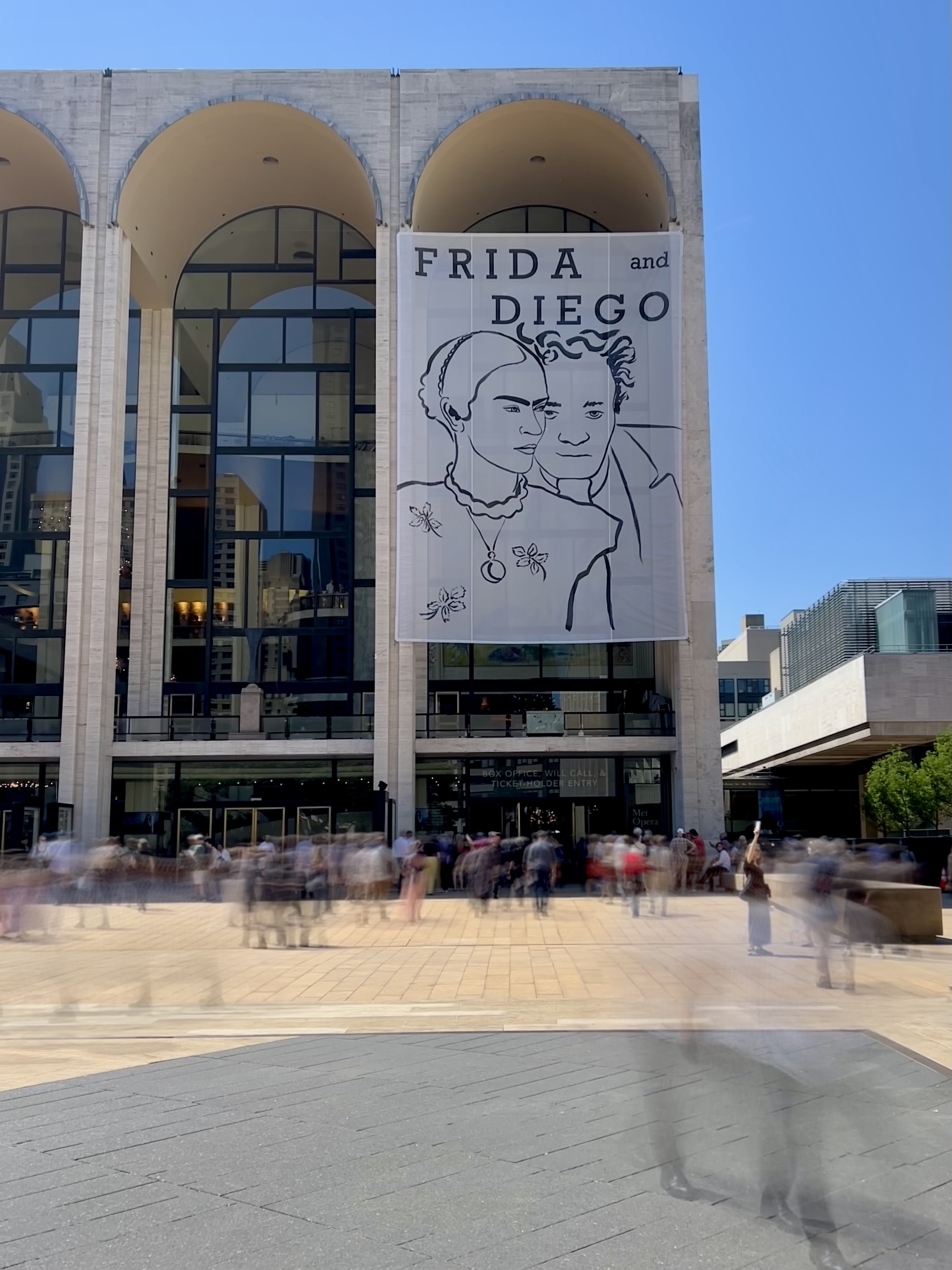
I took my camera to the MoMa exhibit “Frida and Diego: The Last Dream,” which is a collaboration with The Met to promote El Último Sueño. The photos didn’t come out great because I was still very new to manual mode. My digital camera hung around my neck as I took pictures with my iphone. What grabbed my attention the most in the exhibit was an installation of the blue bed frame with a bare red tree coming out of the frame all of which reflected in a mirror hung on the ceiling. The bed and mirror represent the bed from which Frida painted. The tree is an ode to the tree of hope which Frida references in her art and in her diary. The bed, the mirror, and the tree appear in El Último Sueño. The bed and tree reminded me of “Nature Self-Portrait #5,” a photograph by Laura Aguilar. I first encountered Aguilar’s photography as a graduate student and remember being so moved by it. Aguilar’s series “Nature Self-Portrait” and “Grounded” juxtapose Aguilar’s fat naked body alongside nature. Aguilar composes her photographs where the curves, cracks, and ridges of her body resemble that of the ground, boulders, and tree roots. In “Grounded,” even Aguilar’s skin tone blends with the boulders and rock formations of Joshua Tree National Park, where she took the photos. Aguilar’s photographs have changed the ways I understand beauty, queerness, and nature. Her photography was probably the first time I saw a fat Chicana body as art. In “Nature Self-Portrait #5,” Aguilar stands naked on the trunk of a fallen tree, with arms extended toward the sky, and a slight lean to the left. The shadows of the tree branches hit her back, blending her body with the branches and the other trees in the background. Aguilar’s arms emulate tree branches. Aguilar is a tree. I wondered if Frida might have ever thought of her arms as branches on a tree as she painted. Her arms stretched to the sky, even if her body couldn’t. Her body, a tree her bed couldn’t contain. Even as my shoulder ached, I stretched my arm up like a tree branch toward the mirror to snap a selfie.